Chorus
Household chore management app with cascading scheduling that spreads work naturally across time.
3 min read
What is it?
Chorus is a household chore management app I built for couples and small households. The core idea is what I call a ” cascading schedule” system – higher-frequency chores naturally flow into lower-frequency time slots, which ensures consistent work distribution without having to micromanage a calendar.
Daily schedules include one weekly chore, weekly views include one monthly task, and monthly views include one yearly chore. This spreads annual tasks across the year automatically while still allowing manual adjustments when needed.
flowchart LR
    Y["Yearly\nChores"] -->|"1 per month"| M["Monthly\nChores"]
    M -->|"1 per week"| W["Weekly\nChores"]
W -->|"1 per day"| D["Daily\nView"] Try it yourself: https://github.com/loehnertz/Chorus
Why I built it
I got tired of forgetting to do my chores that do not need to be super often. Either everything was ad-hoc and things got forgotten, or we’d try to be systematic about it and end up spending more time planning chores than actually doing them.
I wanted something that would distribute work across time without requiring us to sit down and plan every week. The cascading model removes decision fatigue – you just look at today’s list and do what’s there.
How it works
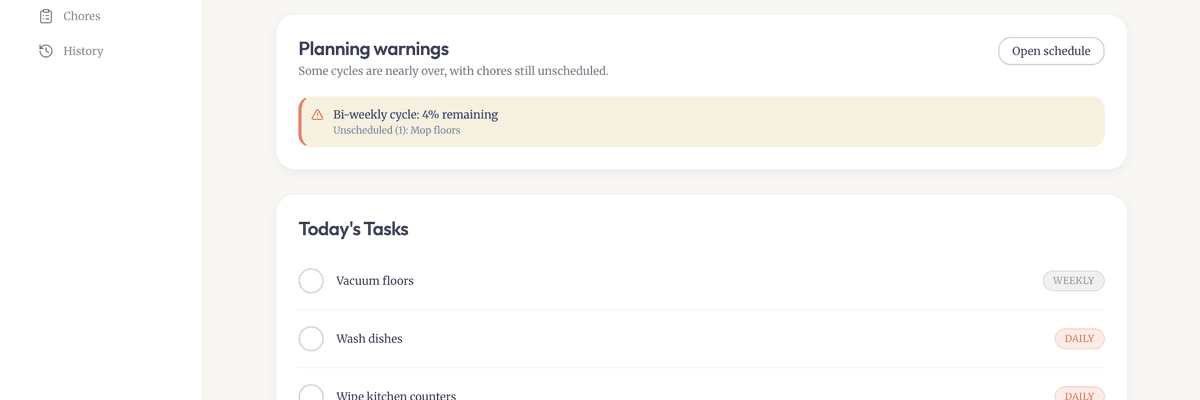
The daily schedule becomes your source of truth where all chores are ultimately resolved. There’s three screens:
- The tasks of today
- A scheduler view where you can pick a chore for a time slot
- A screen with settings for turning on/off notifications and turning on the “holiday mode”
This way, big annual chores (like cleaning the oven or reorganizing storage) just appear in your daily view at the right time without you having to remember them.
Key features:
- Cascading Planning System: Work is distributed across time periods automatically
- Multi-User Support: Task assignment and individual completion tracking for household members
- Smart Suggestions: Prioritizes overdue or never-completed chores, with auto-placement for weekly/biweekly chores on preferred weekdays
- Pace Warnings: Alerts when falling behind on schedules to keep the household on track
- Mobile-First Interface: Optimized for quick interactions on a phone or tablet
Tech stack
I built Chorus with modern full-stack tools:
- Next.js (App Router) + TypeScript for the full-stack application framework
- PostgreSQL via Neon for robust data persistence
- Prisma ORM for type-safe database operations
- Neon Auth (Better Auth) for secure authentication
- TailwindCSS with custom CSS variables for the design system
- Framer Motion for smooth, satisfying animations
- Jest + React Testing Library for comprehensive testing
Each deployment represents a single household where all users share the same chore pool and can view each other’s tasks. Then I don’t have to store anyone’s data. The application is entirely open-source. I recommend deploying it on Vercel.