Tea
Specialty loose-leaf tea, brewed with intention.
12 min read
What?
Basics
High-quality, loose-leaf, specialty tea refers to tea where the exact type with detailed information is sold (e.g., Da Hong Pao) instead of just some random leaves (e.g., Black Tea).
All tea is made from a single plant which also means that what is commonly referred to as tea in the West (ginger, mint, camomile) is as similar oat milk is to milk. At the same time, I am also saying ginger tea so there’s also no reason to be pedantic about it as long as this is known. And in any case, despite the hot water, there’s not much similarity between tea and herbal infusions while there’s also nothing wrong with the latter – it’s just different things.
Types
From the single plant, six general types of tea can be made:
- White (Bai Cha)
- Green (Lü Cha)
- Yellow (Huang Cha)
- Oolong (Wulong Cha)
- Black (called
Redin most of Asia) (Hong Cha) - Dark (post-fermented) (Hei Cha)
The interesting thing about it is though that it’s all made from the same plant called Camellia sinensis and the only thing that differs is the picking and processing style. In theory, all of the above could be made from a single plant while just as in wine, certain cultivars and terroirs lend itself better to specific types.
flowchart TD
    P["🌿 Camellia sinensis"] --> W["White\n≈0-5%"]
    P --> G["Green\n≈5%"]
    P --> Y["Yellow\n≈5-10%"]
    P --> O["Oolong\n15-85%"]
    P --> B["Black\n>85%"]
    P --> D["Dark\nPost-fermented"]
    style W fill:#f5f0e0,stroke:#000,color:#000
    style G fill:#a8d5a2,stroke:#000,color:#000
    style Y fill:#f0e060,stroke:#000,color:#000
    style O fill:#d4a060,stroke:#000,color:#000
    style B fill:#8b4513,stroke:#000,color:#fff
style D fill:#4a3728,stroke:#000,color:#fff Here’s an overview over the basic steps per category:
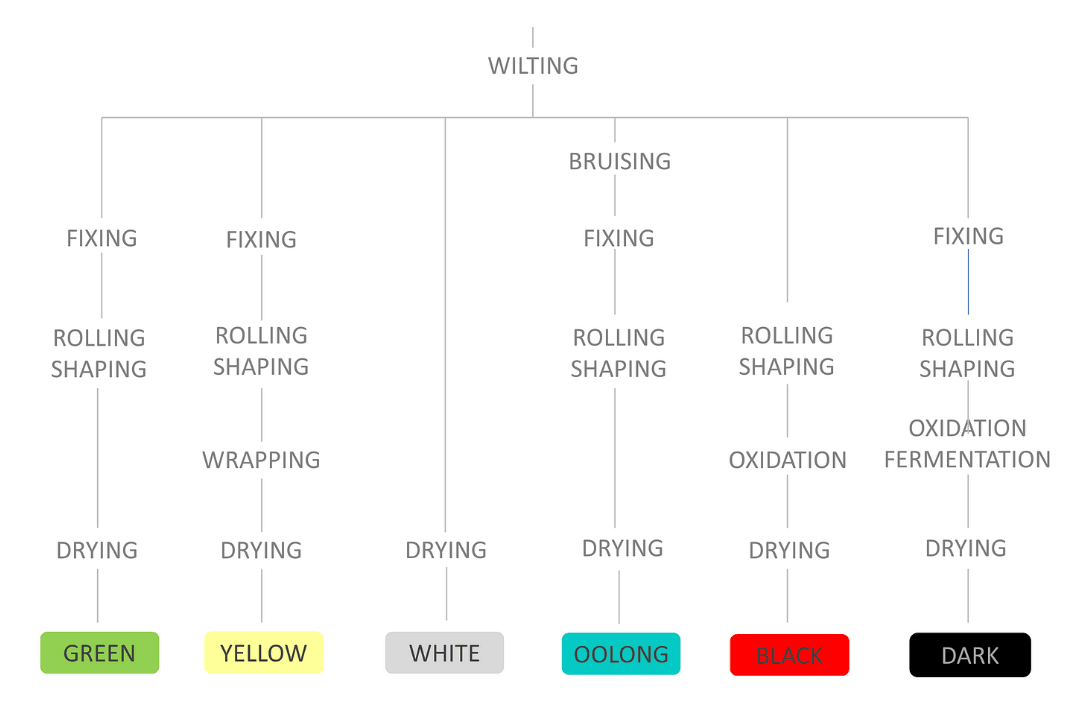
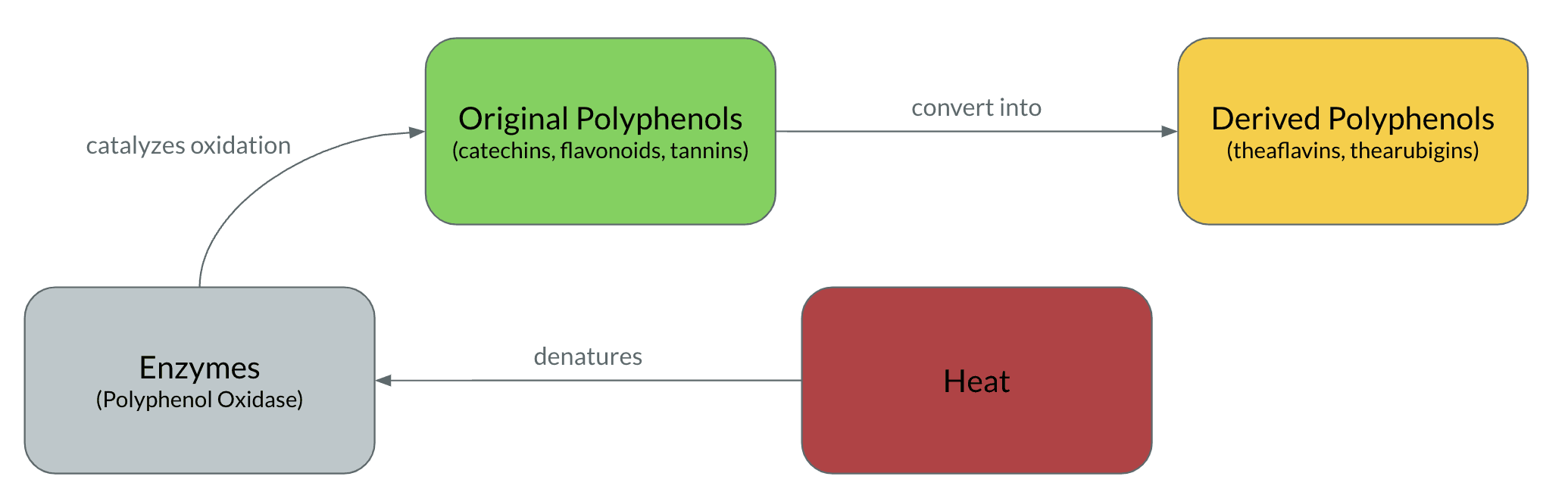
The main process to get from one to another type (although there are way more things that producers can do) is oxidation. In Mandarin Chinese, the words for oxidation and fermentation are the same which led to the erroneous assumption in the West that most tea is fermented. While there is fermented tea (Dark tea (Hei Cha)), in general the important process is oxidation (i.e., oxygen causing mainly the polyphenols in the plant to fall apart or be converted). This means that producers will purposefully bruise the harvested leaves to promote stronger oxidation since more oxygen from the surrounding air will penetrate the leaf. Eventually, the oxidation is stopped as each type of tea and producer has a target oxidation level (can be under 5% as in green tea to over 80% in black tea). Once the target level is reached, heat is added (in various ways) which causes the chemical process to stop or at least slow down to a minimum. I made this diagram for one of my tea tastings that summarizes it:
Categorization
Tea has many parallels with wine (not in terms of flavor) such as:
- Origin
- Harvest year
- Plant cultivars
- Processing styles
- Terroir
At the same time, tea adds another level by additionally having:
- Different harvesting seasons throughout a single year (grapes are harvested once a year)
- Elevation (typically not important for grapes as they need warmer climates)
- Picking styles (typically the entire bunch of grapes is harvested)
Tea has an enormous breadth with hundreds of different cultivars (some ancient, some cultivated) and hundreds of different general types of tea (I made a whole database about it, if you keep reading).
Finally, for wine, the producer plays a big role and its name is usually printed in bold letters on the bottle. Apart from Darjeeling tea from India, this is not really the case with tea.
Origin
The tea plant originally stems from the border region of the current day Yunnan province in China and Myanmar but spread to the rest of China’s East, Taiwan, Japan, and Korea in ancient times by humans transporting it. Later on, due to the foreign influence of British colonizers, they also started growing the plant in India and Sri Lanka. Next to that, loose-leaf tea can be found from Nepal, Vietnam, Kenya, Malawi and a few others.
However, the majority and breadth of specialty tea can be found in China, Taiwan, and Japan. And those three are also what interests me the most in tea as they have a long history with cultivating and processing the plant and therefore insanely many types and diverse flavors.
Brewing
While there are two major methods to brew tea, I have to say that I don’t think one is better than the other. As a matter of fact, I personally would argue that some teas taste better (or more “round”) in one or the other.
Chinese
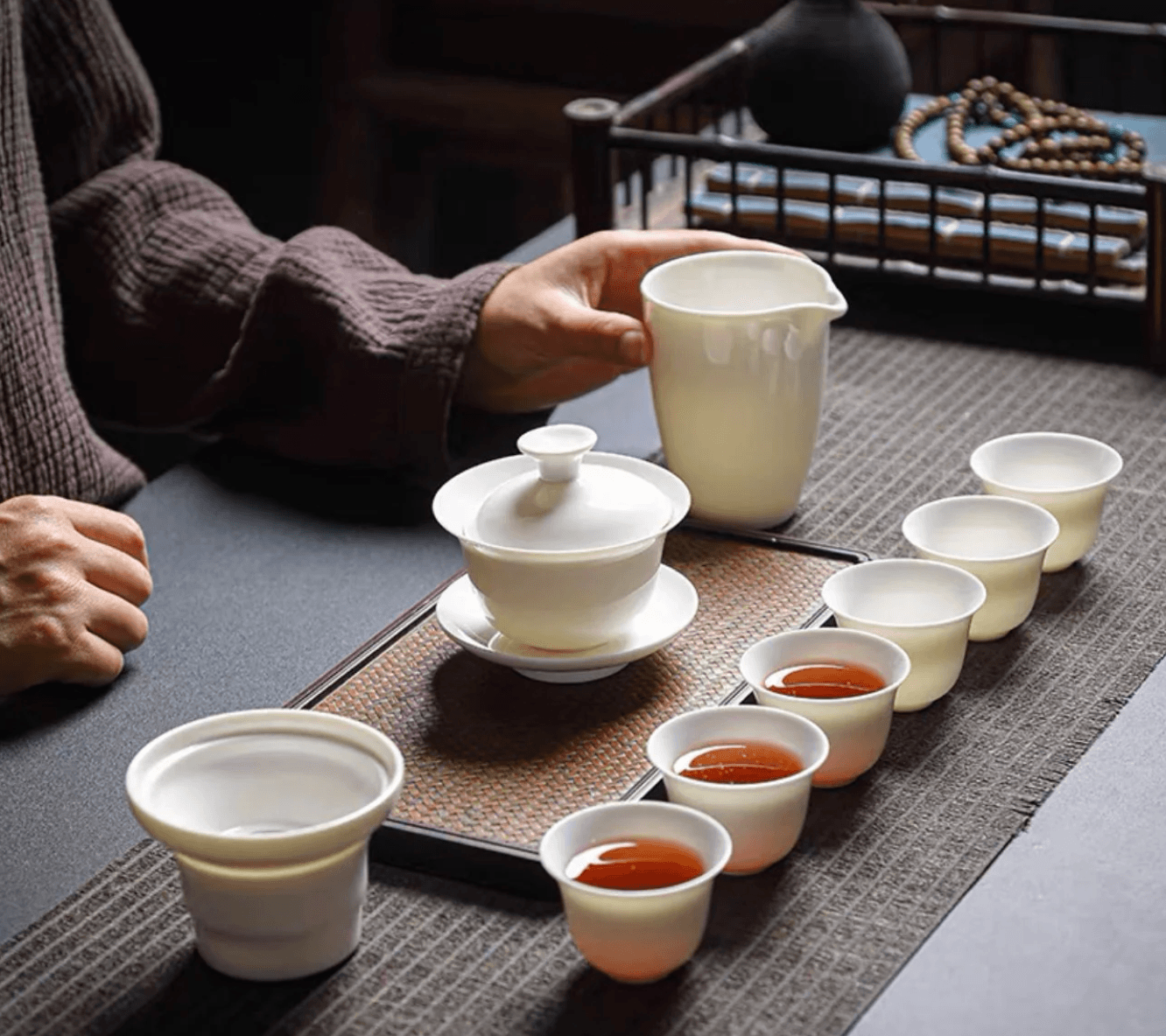
Tea is originally brewed in what is referred to as Gong Fu Cha. The main idea is to go with a high leaf-to-water ratio and instead infuse the leaves only for a few seconds. This allows for evolving infusions over time as different chemical compounds come out at different time after contact with the hot water. It then means that the leaves are re-infused for five to ten times (or even more) for most teas.
It uses a simple bowl with a lid to brew in (Gaiwan), where the lid is used to hold the leaves back, a pitcher to decant the tea liquid into after brewing to ensure all guests get the same strength of brew (Gong Dao Bei), and some very small cups to ensure that the tea cools down fairly quickly as the flavor comes out way better if it’s not scolding hot.
Sometimes, a sieve is used on top of the pitcher to catch stray leaves.
Western
Comparatively, in the West, it’s the norm to use a low leaf-to-water ratio and instead brew for multiple minutes. This also means that most teas can be re-infused but not ten times.
How?
At home, my mom drinks loose-leaf green tea daily, so I occasionally drank some if she made a pot. But I somehow didn’t like it super much as a child and adolescent. It was primarily Japanese green tea, but I now see why, in hindsight, since I got more involved in tea in the last few years, I realized that the typical Japanese green tea flavor is not for me. I much prefer Chinese-style green teas, and my favorites are Chinese and Taiwanese oolong teas at the moment.
I had already become interested in loose-leaf tea a few times and lost interest again until I started to become more involved with it again in 2023. Since then, I haven’t lost interest in it again.
I drink tea daily nowadays, research (read and watch) a lot about the topic, and organize and run a few tastings for other people. Every time, it started with a video I randomly stumbled upon on YouTube (it’s in German), and the guy in the video absolutely fascinated me with the depth that tea has; I didn’t know much about it beforehand. I kept coming back to the video a few times over a longer timespan and eventually started buying some leaf and tea ware to try different kinds myself.
Why?
What I really enjoy about tea is the insane breadth. To most Europeans, tea is drunk from bags or maybe the odd loose leaf, but usually, even then, it’s rarely high-quality specialty tea.
It’s this typical rabbit hole subject to me – it appears a bit boring from the outside, but it’s at the same time relatively easy to get absolutely sucked into, as good tea is quite easy to source due to the internet nowadays.
I enjoy studying the hundreds of types of tea from around the world, where they are from, how they are made, how that affects their aroma and flavor, and learning about the production and the terminology.
Next, I am generally interested in “meditative” experiences. I am typically a calm guy and like chill activities that many would perceive as boring. Sitting down and brewing tea in the original Chinese style is an incredibly soothing, cerebral activity that one can also share with friends nicely. I am saying cerebral because once one gets into the whole tasting aspect of it, it adds another layer to get involved in, and I notice that it is an activity requiring quite some concentration. I heard this quote on some Mei Leaf video (and I think Don quoted someone else):
With tea, the flavor doesn’t come to you, you have to go to the flavor!
And it stuck with me because it’s very accurate. I never really started drinking coffee regularly and don’t drink any alcoholic drinks anymore or anything much but water nowadays, so tea somehow stuck with me because of that. I enjoy the fact that the taste is subtle and elegant.
I also think that due to my parents background in wine making, this might be why this interests me. I was always amazed by the knowledge and terminology that my parents radiated about wine at home throughout my childhood when it comes to origins, varieties, terroir, etc. But at the same time, I don’t drink alcohol, so this topic largely eludes me. As discussed above, the parallels to tea are striking and thus I think I found my parent’s passion within the world of tea for myself!
Finally, I think tea deserves better than it’s treated in the West usually. Most people only use tea bags with boring or worse artificially scented tea. At that point, getting one of these mineral waters with taste would be easier. It heard a comparison once somewhere which I can only repeat and paraphrase:
Despite wine being so similar, it would be absolutely unthinkable, even for casual wine drinkers, to go to a store and just buy a bottle saying
White Wineand leaving again. No year, no grape variety, no origin, nothing. Yet, that is how far it gets with most tea sold over here – it’sBlack Tea!
And I think it’s so easy to brew a great cup of tea compared to even something like coffee that requires a machine or some specialized equipment that quickly becomes very expensive. Instead with tea, a simple sieve and a random cup are all you need. Ideally a scale and a thermometer if you want to be getting the best cup possible, but that’s not even required. Long story short, I also feel like playing ambassador a bit for this great beverage!
Projects
Application: Tea Timer
I am of the faction to do everything very precisely when it comes to tea brewing. So I will always have a tiny scale and a thermometer around. It still allows me to experiment; it’s not that I stick to strict guidelines, but if I try something, I want to know how I arrived at that brew.
Due to this, I wanted an app that would let me set up an infusion timer and run it. I also wanted it to save the current session settings in case I closed the browser tab.
After not finding really anything that came close, I figured that I should just develop my own:
It’s available under https://tea-timer.com/ and can even be installed offline as a progressive web app (PWA). See more on the About page.
Database: Teas of the World
As you can tell, with this whole public side of my Notion, I like writing stuff down, making databases, making lists, etc.
So, I created various things on the topic of tea.
The first I’d like to share is my database of all the types of teas worldwide. I am actively maintaining it and keep adding new ones if I find them. I am sure it’s not complete yet, but I am also confident I am about 80-90% there with the help of the internet.
You can find it here on Notion:
I categorized all kinds of teas I am aware of according to various categories. Additionally, I created a template for a small write-up for every single one and used GPT4o to fill it in for each of them. I tried to fact-check it as I let it generate these texts but after having tried it for a few I knew a lot about, I figured it’s the easiest way to get a basic setup going. Now, I am correcting the texts as I go, as there are small mistakes here and there, although I am very impressed overall with the accuracy, quality, and speed of the new model that OpenAI came up with.
Database: Tea Merchants
After trying to buy high-quality tea offline, I got frustrated very quickly. I tried many shops and while there are really nice ones in the world, they are also rare. Most tea shops in the inner cities of the world sell what is a lot better than what can be bought at a supermarket but I wouldn’t consider it specialty in the sense that if one gets more information than just the country of origin and maybe the harvesting season, that’s already great.
Born out of this frustration, I instead looked online and frankly found a similar picture there. Most sellers seem to not know themselves either, where the product they sell and oftentimes highly praise is even from and how it was made.
Due to this, I created a Notion database with almost all the tea sellers I ever stumbled upon that at least in theory sell specialty, loose-leaf tea (some get it right more than others of course) and categorized all of them according to some basic criteria:
- Where they ship from
- The basic categories of tea they offer
- The information they pass along to the customer
- The breadth of their selection
- The price point (it’s always the price for 1g of Da Hong Pao when bought in a 50g package)
- A subjective rating of mine based on the other criteria
Keep in mind that this database is made from a perspective of a European customer. There are way more merchants in the US, but they either do not ship to the EU or it’s obscenely expensive. Secondly, since I am more interested in East Asian teas, the selected merchants also mostly sell those.
With all that said, here’s the database:
Blog: Reviews
Coming soon…
PDF: Tasting Note Sheet
For the tasting sessions I hold, I created this sheet as I was not happy with any of the ones I found online (neither free, nor paid) as they focused on the wrong things in my eyes. I might update this in the future still:
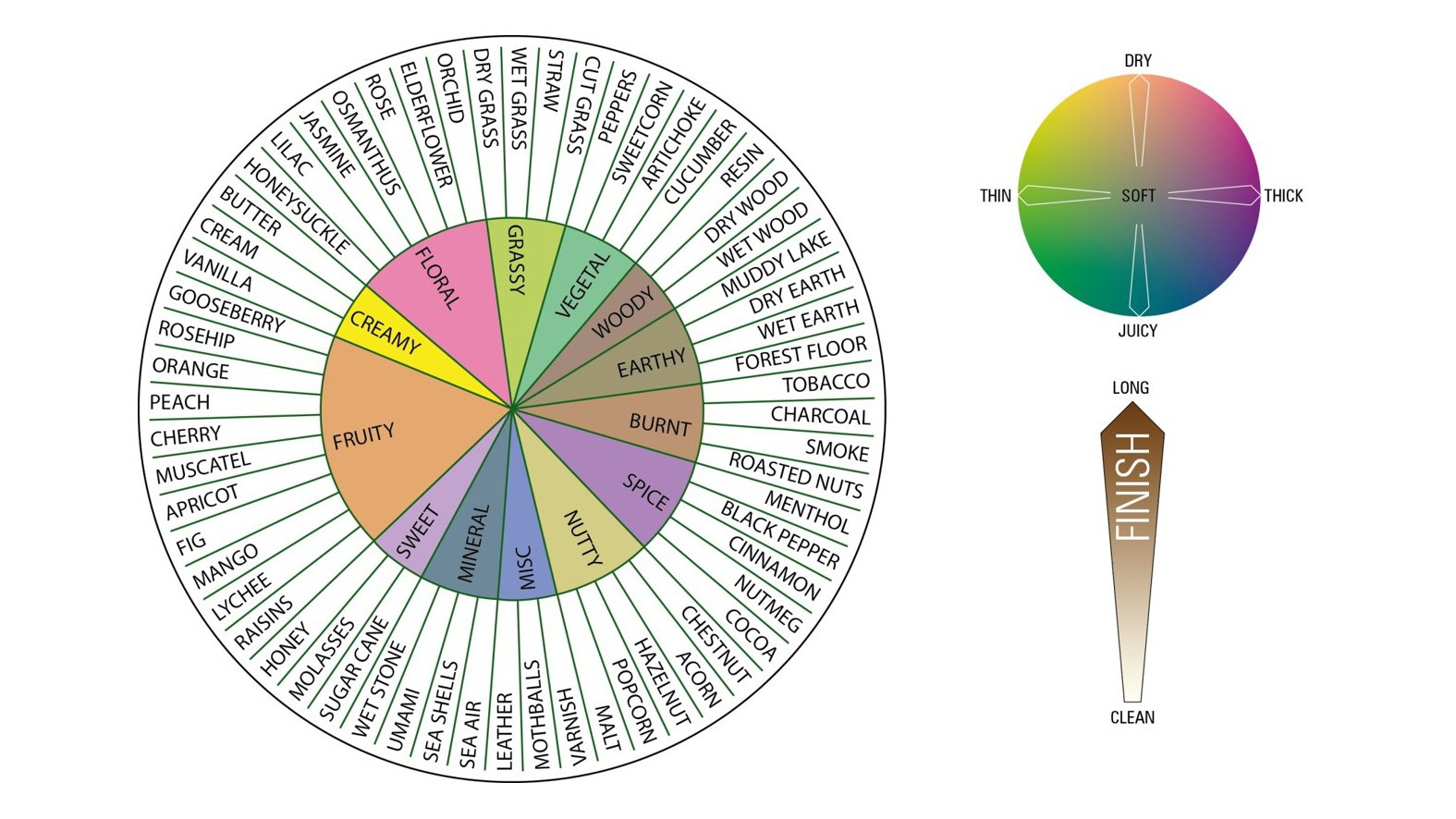
Furthermore, I can highly recommend this helper sheet for flavor and mouthfeel notes by Mei Leaf: